
Migratory bird in Asia "Spike and the world that Ito Dents have seen" Vol.4 Spurious imitation
How many friends do not meet only New Year's cards, but meet each year at least once? It is a friend I met Mr. Itoh who is this hero this year 16 years ago and I meet at least once each year. In Vol.4, I heard about circumstances of the practice range of the Maldiv League and the technique to appeal abroad.
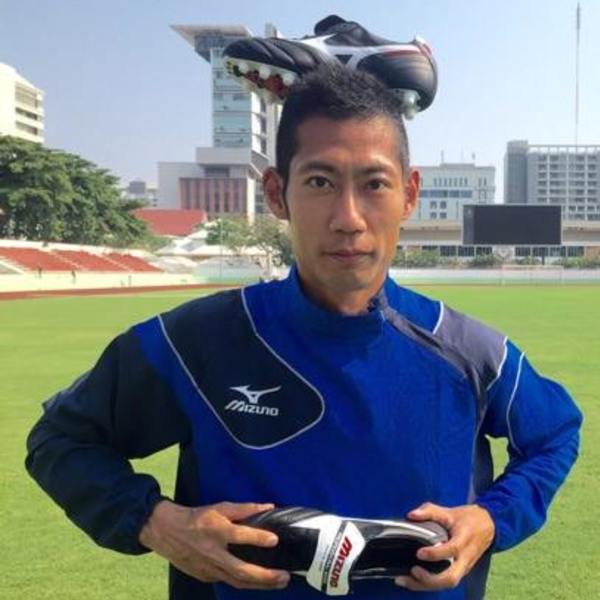 Koike Kikuchi
|
2017/10/09
<From Vol.1 is here>
<From Vol. 2>
<From Vol.3 is here>
—It's an interesting mindset to have the money to buy a bib but choose not to because you understand the situation without it.
ItoIt's probably a matter of national character. What was interesting about my previous team in East Timor was that they had two training kits: one was fluorescent yellow and the other was a maroon color. On the days when the training kit was yellow, the bib they gave us was lime green.
The bibs and practice uniforms were almost the same color, so even though they were wearing bibs, it was hard to tell who was on our team and who was on the enemy team. Also, we had a practice match where our team was wearing fluorescent yellow uniforms, the opposing team was wearing mustard-colored uniforms, and the referee was wearing a normal yellow shirt.
They seem like allies from every angle, but I don't think they even notice that.
—Is it something like, "You understand, right?!"?
ItoIf they were Japanese, they'd definitely complain even about amateur soccer. They'd say things like, "I don't understand!"
—Absolutely. I think we'd say the same thing in our casual futsal games too. In a way, that's pretty impressive.
ItoTo put it positively, you're tough. It's the country you chose to come to, and I think being a professional means achieving results in the environment you're given. I tell myself that even this situation with everyone in yellow shirts is practice for maintaining my field of vision.

—Are there any other stories that you found particularly amazing?
ItoMaldives is a small country with few grounds, so although there is one artificial turf field next to the football association, it's not used very often, so we practice in a kind of open field next to it.
There is a ground on the soil close to the sand, there is also a goal for a while, where I practice there, but I'll do it with Treschue without wearing a spike.
Because there aren't many grounds available, other teams can't secure one either, so pretty much every team ends up practicing there. The team that's playing the next day is practicing set pieces right next to us, and we can hear everything they're saying (laughs).

—It's like the baseball team and the soccer team are practicing together on the same field, right?
ItoSince we start practice at the same time, brothers who belong to different teams come together on their bikes, practice with their respective teams, and then zoom off together on their bikes when practice is over.

--It's kind of like a school club activity. The Maldives also has dirt or sand fields, but recently, artificial turf fields are becoming more common in Asia as well, aren't they?
ItoIn recent years, artificial turf has become mainstream in various Asian countries as times have changed. Personally, I always thought of artificial turf as a field for training shoes, so I've been using training shoes more often.
--The grass in Cambodia used to be in bad condition, but recently there are more artificial turf fields, right? I remember being forced to practice in some really awful places before, but it's gotten better now.
ItoThe National Stadium in Bhutan used to have natural grass, but I guess the climate there isn't suitable for growing grass. It might also be because they don't know much about maintenance, but the ground was really bumpy. However, it's been artificial turf for the past few years, and artificial turf has become more common over time.
—I think the difficulty of overseas tryouts lies in the grounds. Even during practice matches in Cambodia, there were holes in several places on the field, and the grass was very deep, which is very different from Japan. In Bolivia, I even sprained my ankle after falling into a hole in the field (laughs).
ItoThe Phnom Penh Crown team in Cambodia practices in facilities comparable to those of J.League clubs, but the grounds of the team I used to play on were so deep that you'd sink up to your ankles in the grass.
—It will require more skills, won't it? But if you have the right skills, you can adapt, right?
ItoUltimately, it comes down to adaptability. For example, if the field is like this, you might choose a different play. I think even if Beckham were playing on a bumpy field in Nepal, he'd still deliver a beautiful cross.
—So you mean because they have the skills?
ItoI think he'll get a feel for the field conditions through warm-ups and everything, and then he'll make a superb play. Those who are capable will just be able to do it. Even in those kinds of situations.
—Also, the Mongolian league was quite shocking, but weren't there set times for when the hot showers were available? I remember people fighting over them when they announced, "Now the hot showers are available!"
ItoYeah, Mongolia was really cold. In winter it gets down to -40℃ and your contact lenses can even crack.
--The grounds were good, right?
ItoIt was artificial turf, you see. In terms of gear, my luggage is clearly different depending on whether I'm going to a hot country or a cold country. When it's cold, I bring gloves and long tights. When I go to a hot country, I'm only given short-sleeved shirts or polo shirts, but when I go to a cold country, I'm given winter clothes, so my luggage increases dramatically.
—Also, as part of your self-branding, you made an effort to wear stylish clothes when you went to take tests, right?
ItoI think this applies not only to soccer, but if you go to a job interview with messy hair and worn-out clothes, you won't make a good first impression, right? It's the same with soccer; if you go dressed properly, or rather, dressed in a way that makes you look like you're good at it, your first impression changes and you come across as someone who seems capable.
First impressions are incredibly important, as they can completely change your starting line. If someone makes a good first impression and then plays well, people think, "Wow, they're amazing!" But if someone makes a bad first impression and plays the same way, people might think, "Maybe they're not so bad," and that's when they finally get to the starting line. It's like starting from a negative position.
Also, I think that you are confident that you are wearing a cool spike or a prominent spike. Because I think that you are confident that the other party is wearing that kind of thing.

—It's true that confident players tend to wear flashy, stylish spikes. Do you ever get asked about your spikes by local players when you're overseas?
ItoNo matter which country you go to, Japanese products always attract attention because of their high quality. I also often get asked if they're genuine or fake. There are so many athletes overseas wearing fake Adidas and Nike shoes. People often look at my cleats and ask if they're real or original.
—Indeed, I was often asked "Is this original?" in both Asia and South America.
ItoIt's interesting to start the conversation not with which manufacturer is best, but with whether it's genuine or fake. There are even countries where the national team wears counterfeit uniforms.
To be continued in Vol. 5.http://king-gear.com/articles/517
Photo: Yuuki Kuga, Ito Dental
<From Vol. 2>
<From Vol.3 is here>
—It's an interesting mindset to have the money to buy a bib but choose not to because you understand the situation without it.
ItoIt's probably a matter of national character. What was interesting about my previous team in East Timor was that they had two training kits: one was fluorescent yellow and the other was a maroon color. On the days when the training kit was yellow, the bib they gave us was lime green.
The bibs and practice uniforms were almost the same color, so even though they were wearing bibs, it was hard to tell who was on our team and who was on the enemy team. Also, we had a practice match where our team was wearing fluorescent yellow uniforms, the opposing team was wearing mustard-colored uniforms, and the referee was wearing a normal yellow shirt.
They seem like allies from every angle, but I don't think they even notice that.
—Is it something like, "You understand, right?!"?
ItoIf they were Japanese, they'd definitely complain even about amateur soccer. They'd say things like, "I don't understand!"
—Absolutely. I think we'd say the same thing in our casual futsal games too. In a way, that's pretty impressive.
ItoTo put it positively, you're tough. It's the country you chose to come to, and I think being a professional means achieving results in the environment you're given. I tell myself that even this situation with everyone in yellow shirts is practice for maintaining my field of vision.
—Are there any other stories that you found particularly amazing?
ItoMaldives is a small country with few grounds, so although there is one artificial turf field next to the football association, it's not used very often, so we practice in a kind of open field next to it.
There is a ground on the soil close to the sand, there is also a goal for a while, where I practice there, but I'll do it with Treschue without wearing a spike.
Because there aren't many grounds available, other teams can't secure one either, so pretty much every team ends up practicing there. The team that's playing the next day is practicing set pieces right next to us, and we can hear everything they're saying (laughs).
—It's like the baseball team and the soccer team are practicing together on the same field, right?
ItoSince we start practice at the same time, brothers who belong to different teams come together on their bikes, practice with their respective teams, and then zoom off together on their bikes when practice is over.
--It's kind of like a school club activity. The Maldives also has dirt or sand fields, but recently, artificial turf fields are becoming more common in Asia as well, aren't they?
ItoIn recent years, artificial turf has become mainstream in various Asian countries as times have changed. Personally, I always thought of artificial turf as a field for training shoes, so I've been using training shoes more often.
--The grass in Cambodia used to be in bad condition, but recently there are more artificial turf fields, right? I remember being forced to practice in some really awful places before, but it's gotten better now.
ItoThe National Stadium in Bhutan used to have natural grass, but I guess the climate there isn't suitable for growing grass. It might also be because they don't know much about maintenance, but the ground was really bumpy. However, it's been artificial turf for the past few years, and artificial turf has become more common over time.
—I think the difficulty of overseas tryouts lies in the grounds. Even during practice matches in Cambodia, there were holes in several places on the field, and the grass was very deep, which is very different from Japan. In Bolivia, I even sprained my ankle after falling into a hole in the field (laughs).
ItoThe Phnom Penh Crown team in Cambodia practices in facilities comparable to those of J.League clubs, but the grounds of the team I used to play on were so deep that you'd sink up to your ankles in the grass.
—It will require more skills, won't it? But if you have the right skills, you can adapt, right?
ItoUltimately, it comes down to adaptability. For example, if the field is like this, you might choose a different play. I think even if Beckham were playing on a bumpy field in Nepal, he'd still deliver a beautiful cross.
—So you mean because they have the skills?
ItoI think he'll get a feel for the field conditions through warm-ups and everything, and then he'll make a superb play. Those who are capable will just be able to do it. Even in those kinds of situations.
—Also, the Mongolian league was quite shocking, but weren't there set times for when the hot showers were available? I remember people fighting over them when they announced, "Now the hot showers are available!"
ItoYeah, Mongolia was really cold. In winter it gets down to -40℃ and your contact lenses can even crack.
--The grounds were good, right?
ItoIt was artificial turf, you see. In terms of gear, my luggage is clearly different depending on whether I'm going to a hot country or a cold country. When it's cold, I bring gloves and long tights. When I go to a hot country, I'm only given short-sleeved shirts or polo shirts, but when I go to a cold country, I'm given winter clothes, so my luggage increases dramatically.
—Also, as part of your self-branding, you made an effort to wear stylish clothes when you went to take tests, right?
ItoI think this applies not only to soccer, but if you go to a job interview with messy hair and worn-out clothes, you won't make a good first impression, right? It's the same with soccer; if you go dressed properly, or rather, dressed in a way that makes you look like you're good at it, your first impression changes and you come across as someone who seems capable.
First impressions are incredibly important, as they can completely change your starting line. If someone makes a good first impression and then plays well, people think, "Wow, they're amazing!" But if someone makes a bad first impression and plays the same way, people might think, "Maybe they're not so bad," and that's when they finally get to the starting line. It's like starting from a negative position.
Also, I think that you are confident that you are wearing a cool spike or a prominent spike. Because I think that you are confident that the other party is wearing that kind of thing.
—It's true that confident players tend to wear flashy, stylish spikes. Do you ever get asked about your spikes by local players when you're overseas?
ItoNo matter which country you go to, Japanese products always attract attention because of their high quality. I also often get asked if they're genuine or fake. There are so many athletes overseas wearing fake Adidas and Nike shoes. People often look at my cleats and ask if they're real or original.
—Indeed, I was often asked "Is this original?" in both Asia and South America.
ItoIt's interesting to start the conversation not with which manufacturer is best, but with whether it's genuine or fake. There are even countries where the national team wears counterfeit uniforms.
To be continued in Vol. 5.http://king-gear.com/articles/517
Photo: Yuuki Kuga, Ito Dental

LoveGearContent|
2020/02/07
Koki Anzai talks about the reason why he went to Portugal vol.2 "Play style is to give propulsion and get involved with allies"

LoveGearContent|
2020/01/31
Vol.1 "I want to polish the defense side" about the reason why Anzai Yuuki went to Portugal

LoveGearContent|
2019/04/26
Daichi Shibata (Sint-Truiden VV) interview Part 2: "Why are you able to mass produce scores in Belgium?"
LoveGearContent|
2019/04/25
Daichi Shibata (Sint-Truiden VV) interview first part "I decided to go to Europe"

LoveGearContent|
2018/10/21
Ken'o Takeyasu (Sint Troyden) interview "Vol.5 I think that I will continue to receive stimulation from now on Abyspa"
LoveGearContent|
2018/10/19


