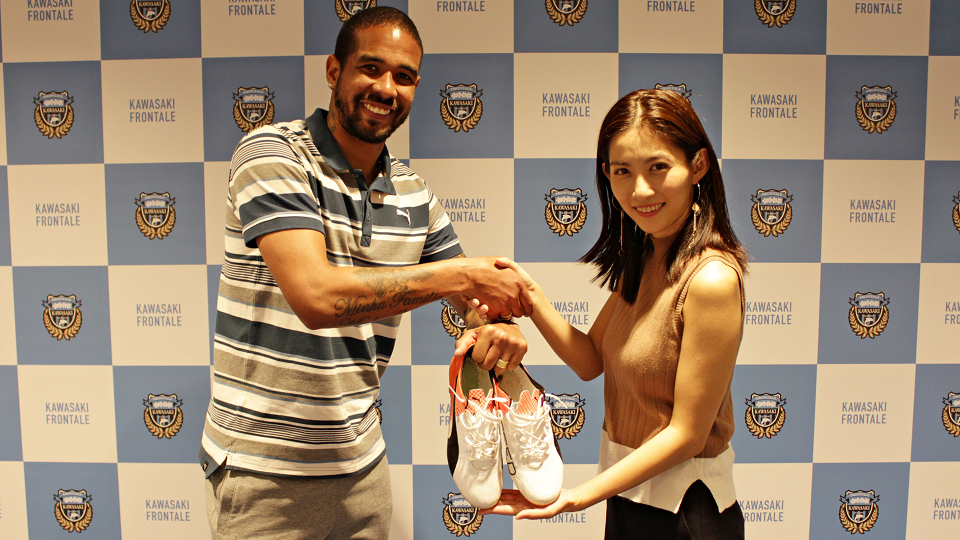
Catheri's "My First Spike" 4th Eduardo Net (Kawasaki) vol. 2 "Ronaldo wearing model that I bought for pocket money"
"My first spike" exploring the roots of foreign players based on the keyword "What is the spike you wore for the first time?" Eduardo net players active as a volunteer for Kawasaki Frontale. Interviewer is Rie Kato actress.
 Tomoyuki Suzuki
|
2016/11/22
Tomoyuki Suzuki
|
2016/11/22
Kato: Were there any cleats you wanted when you were a kid?
NetWhen I was a child, I didn't have many material desires. As long as I could play soccer, I was happy even if I was barefoot (laughs).
KatoWhen Nett first started wearing cleats, what models were his friends wearing?
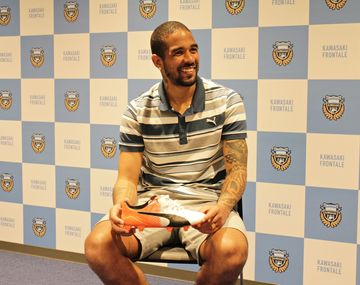
NetThere was a barefoot son, and in famous places it is "TOPPER" (topper). Nike 's model worn by the players of Selec - tion (Brazilian representative) was so expensive that there was no one wearing it. Sometimes I wanted to wear the model that the top player wears, but I could not buy it because it was expensive. I bought it at last when I was 15 years old, because I made money.
KatoWhat model was it?
NetThese are black Nike Mercurials. I believe they were the same model worn by Phenomenon (Portuguese for "monster," a nickname for Ronaldo).
KatoHow did you save money?
NetI would save my allowance instead of spending it, or when my mother gave me money to buy clothes, I would buy cheap clothes and keep the change. I also saved money by eating snacks from my friends instead of spending it myself (laughs).
KatoSince taxes are high in Brazil, if you buy cleats in Japan, they cost about half the price they would in Brazil, right?
Net: Maybe so. When buying things in Brazil, the tax is very high. Regarding hospitals and educational institutions, we have to pay a lot of money even though the environment is not in place.
KatoI've heard that in Brazil, if you wear nice shoes, you'll be targeted by robbers. Is that true?
Net: In some places it can be violent (laughs). Brazilians know that, so everyone walks around in sandals. It's hot outside, so sandals are enough.
KatoIn Brazil, you often see shoes hanging on power lines, right?
NetYes, that's right. We play by throwing our worn-out shoes over our heads and letting them get caught on the power lines. If a friend is wearing worn-out shoes, we throw them towards the power lines and say, "Go ask your mom to buy you some new ones!" (laughs). It's quite common in Rio.
Kato: I heard that net players like the movie "City of God". I also like that series "City of Men" (Brazilian popular drama), but I heard that episodes of shoes have appeared several times in that drama, right?
NetYes, that's right. Since the drama was set in a poor area, they might have included episodes like that.
KatoI was wondering what that feeling is like. In Japan, shoes are rarely featured in drama episodes.
NetPerhaps, since the drama is set in a favela (slum) in Brazil, it wants to convey the message that "simplicity is wonderful." What constitutes happiness in a life of poverty? It might be an attempt to express that in the drama.
Kato: Netto, you were able to attend soccer school from a young age and had your parents buy you cleats, so you weren't living in poverty, right?
NetYes, I was able to wear shoes.
KatoDid you have any friends who wanted shoes but couldn't afford them?
NetYes, there were. I used to give those kids my old shoes or shoes that no longer fit.
Kato: I see. Have you ever noticed any difference in how Brazilians and Japanese people feel about shoes?
NetIn Japan, there's a culture where children think carefully about their future from a young age and consider what they need to do now to achieve it. But in Brazil, many people are poor and struggling just to get by day-to-day, so they can't think about the future to that extent. That's why, naturally, even soccer players don't seem to be very particular about their cleats; they're happy with any shoes as long as they're given to wear.
Kato: That's what it is. If a child in Brazil says "Please give me three things you want", many children raise shoes?
Net: I think it's a common choice. Clothes, shoes, or spikes. Some kids might say toys, but I think the first thing they choose is something they can wear, like clothes or shoes. (To be continued in Vol. 3)
<Profile>
Eduardo Neto was born on October 24, 1988, in Bahia, Brazil. After playing for EC Bahia, Botafogo, SC Braga, EC Vitória, ABC FC, and Avai FC in Brazil, and SC Tavriya Simferopol in Ukraine, he joined Kawasaki Frontale in 2016. He is a defensive midfielder who creates attacking rhythm with well-timed ball winning and accurate passes.
Rie Kato (actor, caster) from Tokyo. Have a Japanese Brazilian mother, love soccer and J League. He appeared in various movies, dramas, and commercials as an actor. Appear as a regular expectant at "totoONE" (http://www.totoone.jp). Official bloghttp://ameblo.jp/kato-rie/ Twitter @vi729
NetWhen I was a child, I didn't have many material desires. As long as I could play soccer, I was happy even if I was barefoot (laughs).
KatoWhen Nett first started wearing cleats, what models were his friends wearing?
NetThere was a barefoot son, and in famous places it is "TOPPER" (topper). Nike 's model worn by the players of Selec - tion (Brazilian representative) was so expensive that there was no one wearing it. Sometimes I wanted to wear the model that the top player wears, but I could not buy it because it was expensive. I bought it at last when I was 15 years old, because I made money.
KatoWhat model was it?
NetThese are black Nike Mercurials. I believe they were the same model worn by Phenomenon (Portuguese for "monster," a nickname for Ronaldo).
KatoHow did you save money?
NetI would save my allowance instead of spending it, or when my mother gave me money to buy clothes, I would buy cheap clothes and keep the change. I also saved money by eating snacks from my friends instead of spending it myself (laughs).
KatoSince taxes are high in Brazil, if you buy cleats in Japan, they cost about half the price they would in Brazil, right?
Net: Maybe so. When buying things in Brazil, the tax is very high. Regarding hospitals and educational institutions, we have to pay a lot of money even though the environment is not in place.
KatoI've heard that in Brazil, if you wear nice shoes, you'll be targeted by robbers. Is that true?
Net: In some places it can be violent (laughs). Brazilians know that, so everyone walks around in sandals. It's hot outside, so sandals are enough.
KatoIn Brazil, you often see shoes hanging on power lines, right?
NetYes, that's right. We play by throwing our worn-out shoes over our heads and letting them get caught on the power lines. If a friend is wearing worn-out shoes, we throw them towards the power lines and say, "Go ask your mom to buy you some new ones!" (laughs). It's quite common in Rio.
Kato: I heard that net players like the movie "City of God". I also like that series "City of Men" (Brazilian popular drama), but I heard that episodes of shoes have appeared several times in that drama, right?
NetYes, that's right. Since the drama was set in a poor area, they might have included episodes like that.
KatoI was wondering what that feeling is like. In Japan, shoes are rarely featured in drama episodes.
NetPerhaps, since the drama is set in a favela (slum) in Brazil, it wants to convey the message that "simplicity is wonderful." What constitutes happiness in a life of poverty? It might be an attempt to express that in the drama.
Kato: Netto, you were able to attend soccer school from a young age and had your parents buy you cleats, so you weren't living in poverty, right?
NetYes, I was able to wear shoes.
KatoDid you have any friends who wanted shoes but couldn't afford them?
NetYes, there were. I used to give those kids my old shoes or shoes that no longer fit.
Kato: I see. Have you ever noticed any difference in how Brazilians and Japanese people feel about shoes?
NetIn Japan, there's a culture where children think carefully about their future from a young age and consider what they need to do now to achieve it. But in Brazil, many people are poor and struggling just to get by day-to-day, so they can't think about the future to that extent. That's why, naturally, even soccer players don't seem to be very particular about their cleats; they're happy with any shoes as long as they're given to wear.
Kato: That's what it is. If a child in Brazil says "Please give me three things you want", many children raise shoes?
Net: I think it's a common choice. Clothes, shoes, or spikes. Some kids might say toys, but I think the first thing they choose is something they can wear, like clothes or shoes. (To be continued in Vol. 3)
<Profile>
Eduardo Neto was born on October 24, 1988, in Bahia, Brazil. After playing for EC Bahia, Botafogo, SC Braga, EC Vitória, ABC FC, and Avai FC in Brazil, and SC Tavriya Simferopol in Ukraine, he joined Kawasaki Frontale in 2016. He is a defensive midfielder who creates attacking rhythm with well-timed ball winning and accurate passes.
Rie Kato (actor, caster) from Tokyo. Have a Japanese Brazilian mother, love soccer and J League. He appeared in various movies, dramas, and commercials as an actor. Appear as a regular expectant at "totoONE" (http://www.totoone.jp). Official bloghttp://ameblo.jp/kato-rie/ Twitter @vi729
FeatureArticleContent|
2025/05/02
The pain and determination to remain a "vessel" -- the truth revealed in Netflix's "Naomi Osaka"
FeatureArticleContent|
2025/04/28
The choice of being a "tour coach" -- the reality of Yasuo Nishioka in the "world of competition"
FeatureArticleContent|
2025/04/23
The miracle of a lucky loser - Eva Liss' whirlwind of joy at the Australian Open
FeatureArticleContent|
2025/04/21
The Queen's strength, her shining talent, and signs of recovery: the plays that lit up the Miami Open
FeatureArticleContent|
2025/04/20